Local weather data, from your own field
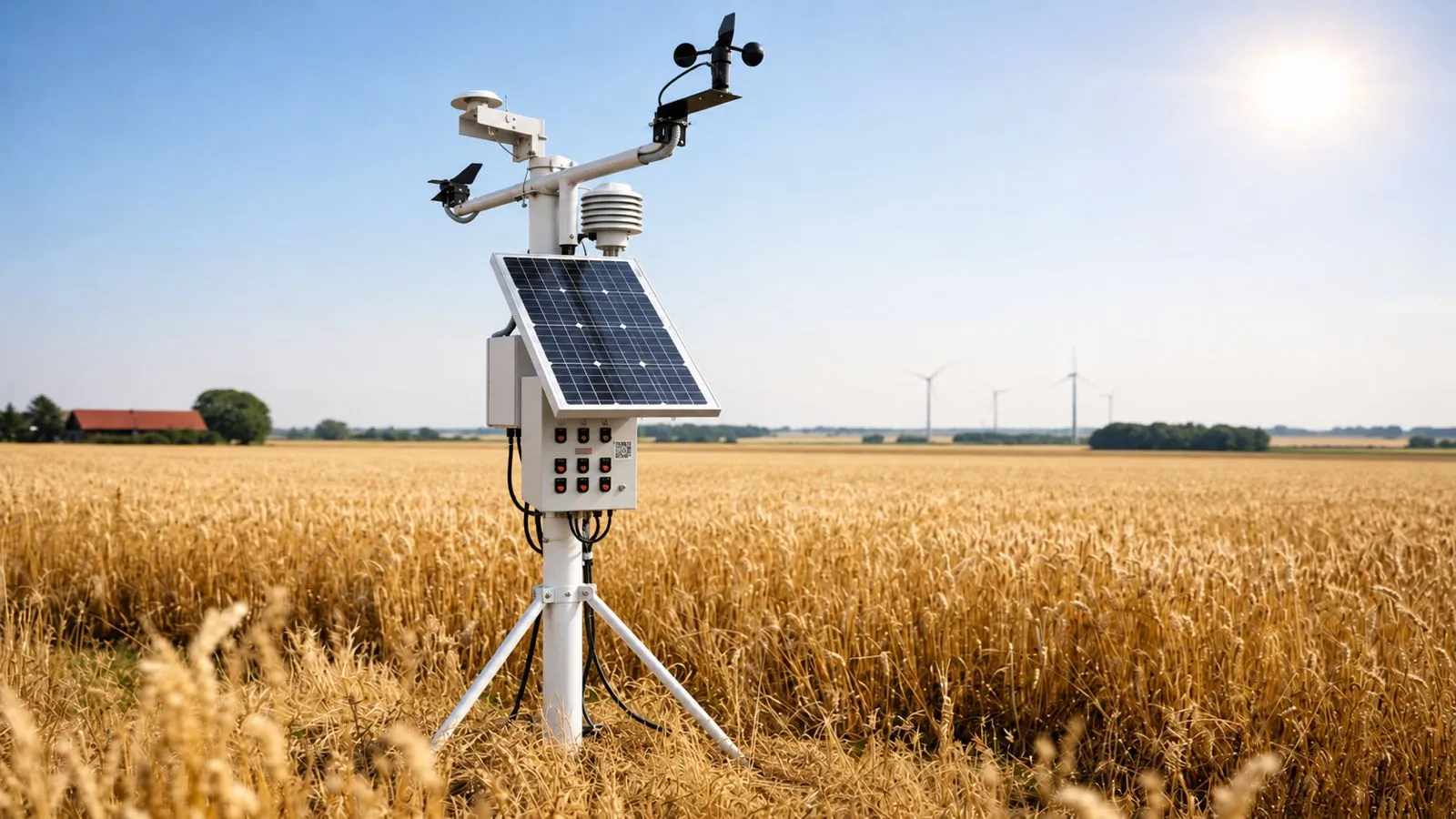
A single-pole, self-powered weather station that puts accurate, real-time conditions where the decisions are made — on the plot, not at the nearest regional station forty kilometres away.
How it works
One pole, full install
Every sensor, the controller, the power system and the uplink mount on a single pole. One person can install it in a morning without site works.
Runs itself
Solar charging with battery buffer, automatic recovery after power or network interruption, and no scheduled maintenance beyond an annual check.
Real-time telemetry
Readings pushed continuously and buffered locally when connectivity drops, so no observation is lost to a weak signal.
Readable at every level
The same data presented as a plain recommendation for a farmer and as raw calibrated series for a researcher.
Built for the field
Sealed enclosures rated for monsoon rain, dust and sustained heat. Designed to sit unattended through a full season.
Open to integration
Data available by API for irrigation control, advisory platforms and institutional research systems.
Why on-location matters
Regional weather data is an average over an area large enough to contain several distinct microclimates. A plot in a valley, shaded in the morning, on heavier soil, behaves differently from the station reporting for the district.
For a decision like do I irrigate today or is this the window to spray, that difference is the entire question. The station exists to close it.
Designed around how it fails
Field hardware does not fail in the ways a lab predicts. It fails because a connection corroded through one monsoon, because the battery drained during a cloudy fortnight, because nobody could get a vehicle out to the site for three months.
So the design priorities were power autonomy, local buffering, automatic recovery, and an install simple enough that it is done correctly by whoever is on site.
Built in collaboration with agricultural research institutions, including deployments with MPKV.
Other products
PIAS
Precision irrigation automation — solenoid control driven by soil, weather and crop-stage data.
IoT & applicationPhule Sanman
Farm mechanisation registry connecting equipment, custom hiring, repair services and suppliers.
Hybrid applicationOSDA
Decision support translating agricultural research into practical, field-ready guidance.
Frequently asked
About Smart Weather Station
What does the Smart Weather Station measure?
Temperature, humidity, rainfall, wind speed and direction, barometric pressure and solar radiation as standard. Soil moisture and leaf-wetness sensors can be added as plot-level extensions without changing the mast or controller.
How is the data accessed?
REST API with authenticated endpoints for live readings, historical ranges and station health. Common consumers are the APx PIAS irrigation controller, OSDA decision support, and third-party analytics and research platforms.
What's the installation and maintenance footprint?
One person, half a day, no civil works. Maintenance is an annual visual check and sensor re-calibration; the solar + battery design runs autonomously through a full season.
Can it integrate with IMD or other weather feeds?
Yes. Local station data can be blended with IMD regional forecasts or any third-party forecast API to feed downstream advisories — especially useful for forward-looking irrigation and spray-window decisions.
Next step
Interested in Smart Weather Station?
Tell us about your deployment — scale, location, and what you need it to connect to. We'll come back with a practical answer.